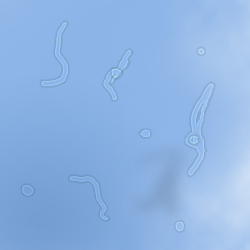
 What causes “eye floaters”.
For those who’ve never experienced this phenomenon, eye floaters are little oddly shaped objects that appear in your vision, often when one looks at bright light such as a blue sky. Their shapes vary greatly, but will often appear as spots, cobwebs, or randomly shaped stringy objects. These are not optical illusions, but rather something your eyes are actually perceiving. There are a few different things that can cause this, but in most cases these eye floaters are caused by pieces of the gel-like vitreous breaking off from the back portion of your eye and then floating about in your eye ball.
The vitreous humor, or often just “vitreous”, is a clear gel that fills the gap between your retina and lens, helping maintain the round shape of your eye in the process. This gel is about 99% water and 1% other elements; the latter of which consists mostly of a network of hyaluronic acid and collagen. Hyaluronic acid ends up retaining water molecules. Over time though, this network breaks down which results in the hyaluronic acid releasing its trapped water molecules. When this happens, it forms a watery core in your vitreous body.
As you age then, pieces of the still gel-like collagen/hyaluronic acid network will break off and float around in this watery center. When light passes through this area, it creates a shadow on your retina. This shadow is actually what you are seeing when you see the eye floaters.
Children and teenagers almost never experience these types of eye floaters as there must first be some deterioration of the gel-like substance in their eye, creating the watery core, for these floaters to appear. However, they do still sometimes experience a certain type of eye floater that often appears more like a crystallized web across their vision. These floaters aren’t found in the vitreous humor like the above floaters. Instead, they are found in the Premacular Bursa area, right on top of the retina. These floaters are microscopic in size and only appear as big as they do because of their proximity to the retina. Unfortunately, their microscopic nature makes them almost impossible to treat in most cases.
Bonus Factoids:
- Interestingly, if the eye floaters would just stay still instead of floating around, your brain would automatically tune them out and you’d never consciously see them. Your brain does this all the time with things both in and outside of your eyes. One example of this inside your eye are blood vessels in the eye which obstruct light; because they are fixed in location, relative to the retina, your brain tunes them out completely and you don’t consciously perceive them.
- The reason you can see floaters better when looking at, for instance, a bright blue sky, is because your pupils contract to a very small size, thus reducing the aperture, which in turn makes floaters more apparent and focused.
- Individual floaters often won’t change much throughout your lifetime, typically retaining their basic shape and size.
- The perception of eye floaters is known as myodesopsia.
- The reason the floating specs never seem to stay still is because floaters, being suspended in the vitreous humor, move when your eye moves. So as you try to look at them, they will appear to drift with your eye movement.
- Eye floaters are examples of entoptic phenomena. Entoptic phenomena are things we see where the source is within the eye itself.
- If you ever see a ton of floaters appear out of no where, possibly with some light flashes, you should get to an eye doctor immediately. There is a chance (1 in 7) that your retina is about to detach from the back of your eye. If that happens, you have very little time to get it fixed before it effectively dies and you go blind from that eye.
- Floaters can damage the retina by tugging on it, sometimes producing a tear. When a tear happens, vitreous can invade the opening in the tear, which will ultimately widen the gap and in 50% of these cases will result in the retina eventually becoming fully detached if not repaired via surgery.
- “Light flashes” not caused by actual light, also known as photopsia, will often occur when the photoreceptors in the retina receive stimulation from being touched or from being torn. This produces an electrical impulse to your brain, which your brain more or less interprets as a light flash. This physical stimulation is often caused when traction is being applied while the vitreous detachment is taking place. The flashes should subside when the vitreous finally detaches.
- These flashes will also often temporarily occur when you get a sharp blow to the head. The sudden jarring causes pressure on the retina; this in turn creates an electrical impulse to the brain which the brain interprets as a flash.
- Yet another potential cause of these flashes is with migraine headaches, usually caused by a spasm of blood vessels in the brain. In this case, you will experience the flashes in both eyes at the same time, often followed by an extreme headache, though this doesn’t necessarily have to follow with a headache. Basically, if you are experiencing these flashes in both eyes at the same time, it is likely caused by either severe head trauma, which resulted in damage to both of your retinas, or more likely by some form of ophthalmic migraine.
- Aside: as someone who has had about 12 of these type of migraines, with the extreme headache directly following about 15-ish minutes of flashes where you can barely see in between the flashes, I can say, it’s like getting kicked in the balls continually for about 3 hours or so, only the pain is in your head instead of balls and abdomen. This is all followed by your eyes having a dull ache for a few days. You will also have major pain in your eyes and possible recurrence of the migraine, if you decide to not wear sunglasses at all times during the few days following this event; including wearing the sunglasses inside where people will inevitably think you are a douche for doing so.

- About 50% of all people will have a vitreous detachment by the time they turn 80.
- If you have had a vitreous detachment and you’ve experienced light flashes with that, you have about a 15% chance of developing a retinal tear. From there, you have about a 50% chance of having your retina eventually become fully detached from the back of your eye.
- Nearsighted people have a much higher chance of experiencing vitreous detachments due to their often elongated eye shape.
- Surgeries do exist for getting rid of eye floaters, if they seriously hamper your vision. This is typically done by replacing the gel-like substance in your eye with a saline liquid.
- When your retina is in the process of detaching, you will often see small dots all over the place. What is happening here is that blood is being leaked into the vitreous and those dots are your visual perception of that blood in your eye.
- Check out this optical illusion for another example of your brain tuning something out based on it being fixed relative to motion; for best affect, once the dots disappear, without looking away, press the stop button; they’ll reappear; press the button again to restart the motion and they’ll disappear instantly.
Dr Mobiles Limited
1 Huron Street
Takapuna, North Shore 0622
Tel: (09) 551-5344
Mob: (021) 117-2222
FaceBook.com - Email - Posterous - Twitter - Blogger - Flickr 1 Huron Street
Takapuna, North Shore 0622
Tel: (09) 551-5344
Mob: (021) 117-2222